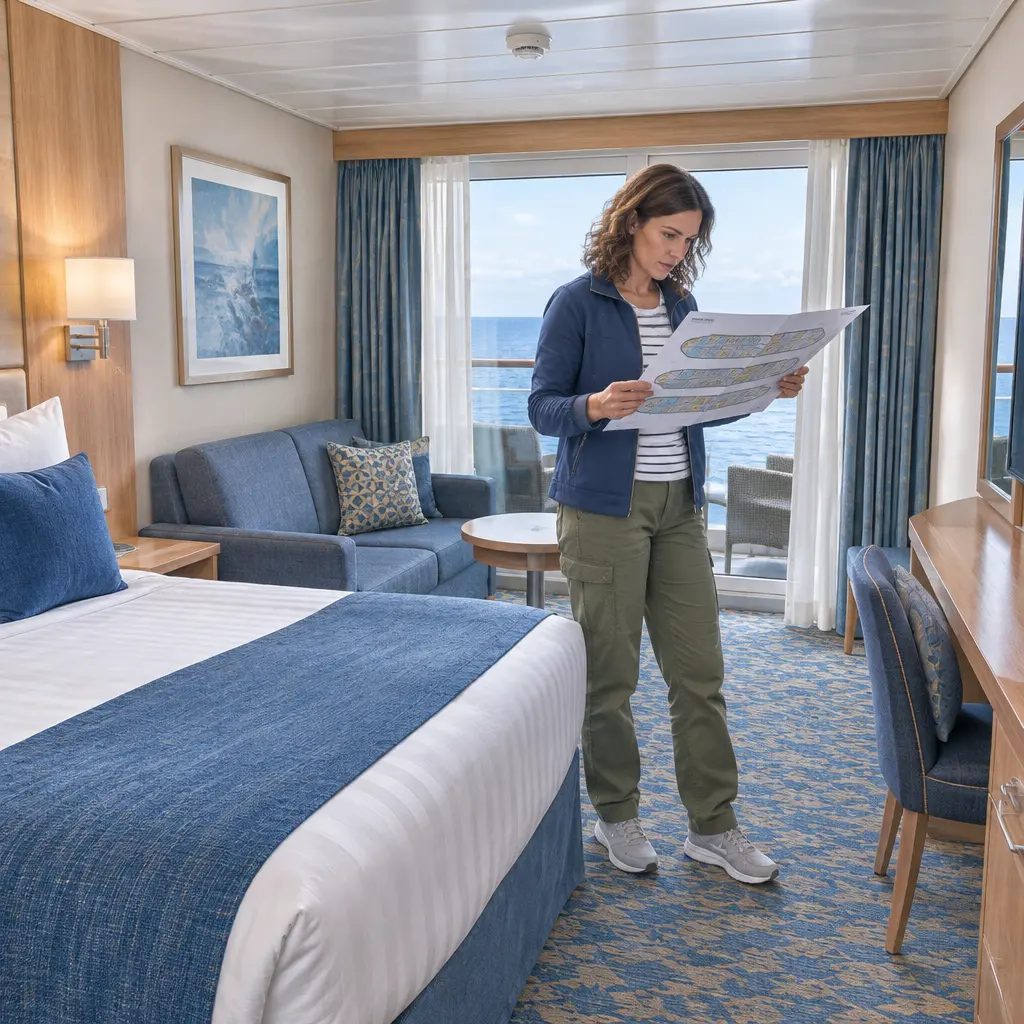
A cruise cabin’s location affects both how much ship motion you may feel and how much noise reaches your room. For travelers sensitive to motion, a lower-deck cabin near the ship’s center is generally a sensible starting point; for noise-sensitive travelers, the best choice depends on what is directly above, below, and beside the cabin. The advice is practical rather than a guarantee: ship design, sea conditions, itinerary, and cabin-specific surroundings all matter. This guide explains the motion-and-noise trade-off, compares cabin locations, and offers a checklist for choosing and verifying a room.
Cruise cabin location balances motion sensitivity and noise exposure
A cruise cabin location is the room’s position on the vessel by deck, distance from the bow or stern, and proximity to public spaces or ship equipment. The two main considerations are motion—the rolling, pitching, and vibration passengers perceive—and noise, including sound from venues, machinery, corridors, and neighboring cabins. The Centers for Disease Control and Prevention’s Yellow Book describes motion sickness as a response to conflicting sensory signals about movement; a cabin cannot prevent that response, but a steadier-feeling location may help some passengers.
There is no universal cabin ranking that predicts comfort on every ship. A lower, central room is commonly recommended for people concerned about motion, while a quiet room is usually one separated from busy venues and machinery. Those preferences can conflict: a low cabin may be near operational spaces, and a high cabin may be close to pools, theaters, or open decks. Treat deck plans as a screening tool, then check the exact cabin and ship.
How cabin position influences motion and noise
Motion and noise are distinct comfort factors. Vessel motion depends on the ship’s movement and the passenger’s position within it; noise depends on the source, the structure between the source and cabin, and the time of day. The International Maritime Organization’s ship-noise code addresses onboard noise as an exposure and design issue, but it does not provide a consumer guarantee that a particular passenger cabin will be quiet.
Motion: lower and nearer the center is a useful rule of thumb
Pitch is the bow-to-stern movement of a vessel, while roll is its side-to-side movement. A cabin closer to the ship’s center and on a lower deck often feels less movement than one high up or far toward the bow or stern. This is a practical rule of thumb, not a promise: sea state, ship size, heading, stabilizer use, and individual sensitivity all influence what a passenger feels. The CDC notes that motion sickness can arise when visual and balance-system signals do not agree, so even a relatively steady cabin may not eliminate symptoms.
Noise: nearby functions matter as much as deck number
Noise exposure is shaped by what lies next to, above, and below a cabin. A room under a pool deck may receive early-morning furniture or cleaning noise; one beside a theater or nightclub may be affected by performances; a cabin near a lift lobby or stairwell may experience repeated foot traffic. Mechanical spaces can produce vibration or operational sound, though the effect varies by ship and by the room’s position.
The motion-noise trade-off
The best location is a compromise based on the traveler’s strongest concern. A low, central cabin may reduce perceived movement but still be inconveniently close to a service area. A quiet midship room on a higher deck may avoid a venue while feeling more motion in rough conditions. When comparing cabins, evaluate the exact room—not just labels such as “midship,” “ocean view,” or “balcony.”
Compare cabin locations by likely comfort trade-offs
The following comparisons are general planning guidance, not measured noise ratings or guarantees. Cruise ships differ in layout, insulation, equipment placement, and operating schedules. Use the ship’s own deck plan and, where possible, cabin-specific reviews to confirm what is around the room.
Midship cabins
Midship cabins are situated nearer the vessel’s center from bow to stern. They are often recommended for passengers concerned about motion because they are farther from the ends, where movement may feel more pronounced. A midship room is not automatically quiet: inspect its position relative to elevators, public rooms, service areas, and cabins with unusual overhead spaces.
Lower-deck cabins
Lower-deck cabins are closer to the ship’s center of rotation than rooms high above the waterline, which may make movement feel less pronounced for some passengers. They can be a practical option for motion-sensitive travelers, especially when also located midship. Check whether the cabin is near crew work areas, loading operations, or machinery, and consider whether the lower location suits your access and view preferences.
High-deck cabins
High-deck cabins can offer convenient access to pools, sun decks, and other top-level facilities. Their height may make vessel movement more noticeable than in a lower cabin, particularly for some passengers in rough seas. Noise risk depends strongly on the deck above: a cabin immediately beneath a pool, buffet, or fitness area may be exposed to activity before or after posted guest hours.
Forward and aft cabins
Forward cabins sit toward the bow, and aft cabins sit toward the stern. Both are farther from the ship’s midpoint than midship rooms and may feel more movement, though actual experience varies with vessel and conditions. Aft cabins may also be near engine-related spaces or outdoor venues on some ships; forward cabins may be near theaters, lounges, or crew facilities. Confirm the surrounding layout rather than assuming one end is always noisier.
Inside, ocean-view, balcony, and suite cabins
Cabin category describes features, not a reliable motion or noise score. Inside cabins have no exterior window; ocean-view cabins have a window or porthole; balcony cabins provide private outdoor space; and suites generally offer more room and additional amenities. Any category can be quiet or noisy depending on location. A balcony may let passengers look at the horizon, which some find helpful when feeling unwell, but it does not physically stabilize the ship or guarantee relief.
Choose a cabin using a practical screening process
Start with your strongest sensitivity
If motion is your main concern, first compare lower, central cabins. If sleep and noise are your priority, focus on cabins buffered from public venues, elevators, stairwells, and operational spaces. If both matter, search for a lower or middle-deck cabin near midship that has passenger cabins above and below it and is not directly beside a busy area.
Read the deck plan in three directions
Check what is beside the room, what sits directly overhead, and what is directly beneath it. Public spaces are easy to spot on many plans, but blank or service-labeled areas may require clarification from the cruise line or a knowledgeable travel adviser. Also check the distance to elevators and stairwells: they can be convenient, but nearby passenger traffic may be a drawback for light sleepers.
Verify the exact cabin number
Cabins within the same category can have different surroundings. Search the exact room number alongside the ship name, and compare reports from more than one source where available. Reviews are anecdotal and may reflect a particular sailing, weather, or neighbor; use them as clues, not proof. Ask the cruise line or travel adviser whether the room is near a venue, crew area, service station, or equipment space.
Consider itinerary, schedule, and access
An itinerary with more open-water sailing may make motion comfort more important than a route with many short port calls, although weather can change any voyage. A cabin near the stairs or lifts may make moving around easier, while a room far from them may reduce passing traffic. Consider mobility needs, nighttime routines, and how often you expect to use nearby facilities along with motion and noise.
Reduce motion discomfort and manage noise onboard
Use non-cabin strategies for motion sensitivity
A cabin choice is only one part of motion planning. The CDC’s Yellow Book advises travelers to understand motion-sickness prevention and treatment options; people with medical conditions, medication concerns, or a history of severe symptoms should seek advice from a qualified health professional before departure. Some passengers find it helpful to look toward the horizon, get fresh air, and avoid reading while the ship is moving, but responses differ and these steps are not a substitute for individualized medical advice.
Plan for noise without assuming a room is soundproof
If you are a light sleeper, pack suitable earplugs or other personal noise-management aids and review the ship’s quiet-hour practices. These measures can reduce some disturbances but will not block every low-frequency vibration or loud sound. If noise is persistent after boarding, contact guest services promptly; staff may be able to investigate the source or discuss available alternatives, depending on occupancy and ship policy.
A simple cabin-comparison chart
Use this qualitative chart as a starting point, not as a ship-specific measurement:
- Lower and midship: often a stronger starting point for motion concerns; still check nearby machinery and services.
- High and midship: may offer convenient access to top-deck amenities; movement may be more noticeable for some travelers.
- Under a public deck: check for possible overhead activity, especially early-morning setup or late-night events.
- Beside a venue or lift lobby: check schedules and passenger traffic; convenience may come with more sound.
- Forward or aft: compare carefully if motion-sensitive; confirm nearby venues and equipment on the ship’s plan.
Conclusion: choose the cabin that fits your priorities
Cruise cabin strategy is about balancing position, surrounding activity, and personal sensitivity. Lower, midship cabins are a common first choice for travelers concerned about motion; for noise, the room’s neighbors and the spaces above and below often matter more than its category. Because ships and itineraries differ, verify the exact cabin on the deck plan, ask targeted questions, and treat reviews as supporting evidence rather than certainty. Before booking, compare two or three specific rooms against your motion, sleep, access, and budget priorities, and consult a health professional if you need medical guidance for motion sickness.
Sources: Centers for Disease Control and Prevention, CDC Yellow Book 2026: Motion Sickness, https://www.cdc.gov/yellow-book/hcp/travel-air-sea/motion-sickness.html; International Maritime Organization, Code on Noise Levels on Board Ships, https://www.imo.org/en/OurWork/Safety/Pages/Noise.aspx